
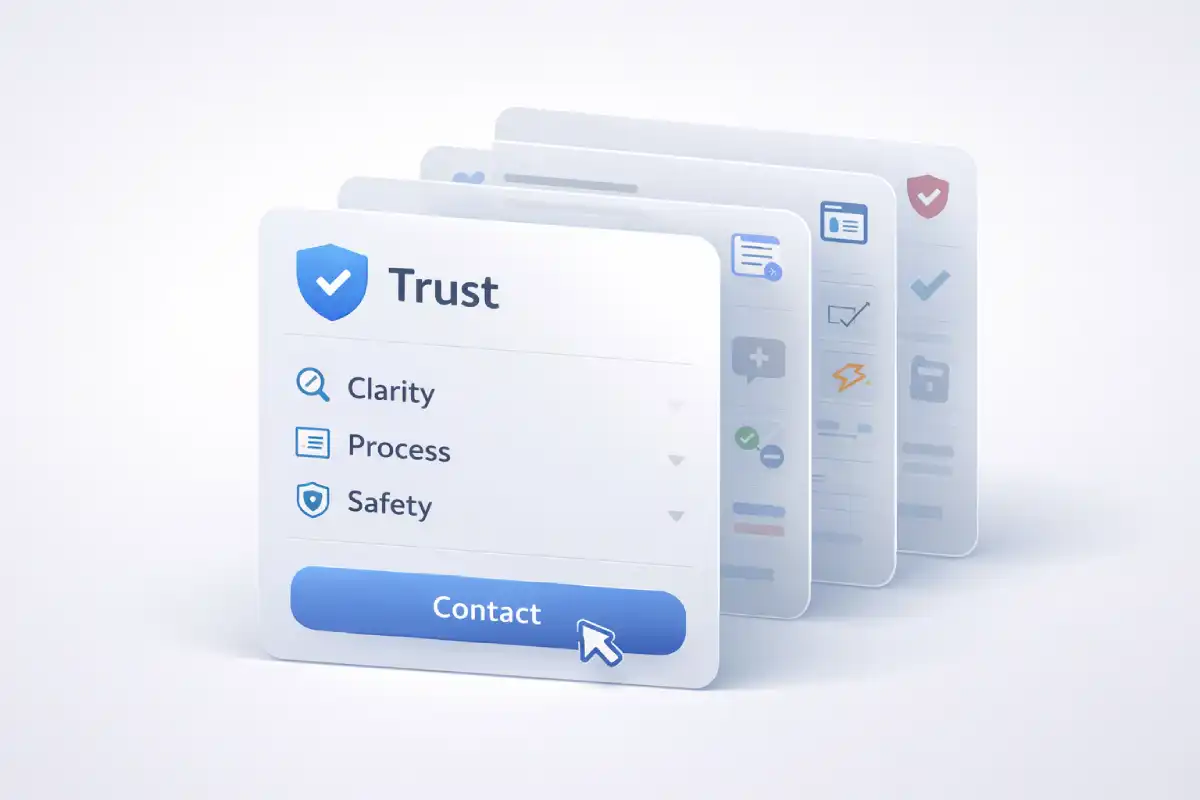
You’re not alone: most businesses don’t have testimonials at the start.
But here’s the uncomfortable truth: visitors still judge your website in seconds. If they can’t find proof, they look for signals.
Testimonials are just one signal. You can build trust without them, by reducing uncertainty and making your website feel safe and credible.
The “trust math” visitors do (without thinking)
People don’t ask “Is this website pretty?” first. They ask:
- Do I understand what you do? (clarity)
- Do you look legit? (credibility)
- Is it safe to contact/pay you? (risk)
Your job is to stack small trust signals until the visitor feels confident enough to take the next step.
If you want the fast version of this concept, read: The 5-Second Website Trust Test.
1) Be painfully clear above the fold
When visitors land, they should understand three things instantly:
- Who you help
- What outcome you deliver
- What to do next
A simple headline formula:
Helping [audience] get [result] with [method] — without [pain].Example:
Helping small businesses get a faster, trust-focused website — without a full redesign.Then make the CTA obvious (one primary action). If your homepage feels “busy,” this article helps: One Screen Offer.
2) Show your process like a product
Testimonials say: “Other people survived working with you.”
A clear process says: “Working with me is predictable.” That lowers risk fast.
Use a simple 3–5 step timeline:
- Audit (what I check + what you get)
- Plan (priority list + timeline)
- Build (implementation)
- QA (testing + fixes)
- Launch (handover + support)
Bonus: add what you deliver in each step. People trust specificity.
If you offer a Free Quick Check, explain what’s inside. (It’s a trust signal by itself.)
3) Use “risk reversal” instead of “hype”
Most websites try to sound confident. Trust websites try to sound safe.
Add a small “risk reversal” section:
- What’s included (and what’s not)
- How revisions work
- How scope changes are handled
- What happens if something breaks after launch
Even one paragraph helps:
No hidden surprises. You’ll get a clear scope before work starts, a timeline, and a checklist of deliverables.
If scope changes, I’ll confirm impact first (time/cost) before touching anything.
This “boring” clarity is trust.
4) Show real work artifacts (even if you can’t share full client work)
If you don’t have testimonials, show evidence of how you think and work.
- Before/after metrics (speed, layout, clarity)
- Screenshots of improvements (blur sensitive info)
- Mini case breakdowns: problem → fix → outcome
Even a simple “what I changed” list builds credibility:
What I fixed:
- Simplified the hero message
- Improved mobile spacing & CTA visibility
- Reduced page weight (images + scripts)
- Improved contact form deliverability
Pro tip: visitors trust “mechanics” more than big claims.
5) Add authority signals that don’t look like flexing
Authority is not “I’m the best.” Authority is “I follow standards.”
Examples of low-ego authority signals:
- Performance habits: image optimization, lazy loading, Core Web Vitals awareness
- Security habits: least-privilege access, clean form handling, no shady plugins
- QA habits: mobile testing, cross-browser checks
If your site is performance-first, link to it. It’s proof:
Speed Fix Checklist (Real-World, No Hype)
6) Be transparent about pricing (even if it’s a range)
Hidden pricing doesn’t always increase leads. Sometimes it increases suspicion.
You don’t need a fixed price, just a range and what affects it:
- Number of pages
- Copywriting needed or not
- Custom design vs template adaptation
- Timeline urgency
Example section:
Most projects fall between $X–$Y depending on scope.
After a quick audit, I’ll confirm the exact scope + quote before we start.
If you already offer packages, keep it simple: View Pricing →
7) Make contacting you feel safe and professional
People hesitate when they feel like:
- They’ll be pressured
- They’ll be ignored
- They’ll get spammed
Reduce that fear with small details:
- Use a business email (you already do)
- Say your response time (example: within 24–1 business days)
- Explain what happens after they submit the form
Example micro-copy:
After you submit, I’ll review your site and reply with 3 priority fixes.
No spam. No pressure. Just clear next steps.
8) Borrow trust ethically (no fake reviews)
Borrowed trust means using legitimate third-party proof:
- Public portfolio links
- GitHub repositories (if relevant)
- Telegram/YouTube content where you share fixes
- Professional profiles (LinkedIn, etc.)
It works because the visitor can verify you exist outside your website.
Bonus: link to your “how I work” / “Free Quick Check” article to show depth: Free Quick Check: What I Check
9) Add micro-credibility: FAQ + policies + boundaries
People trust businesses that have boundaries.
Add a short FAQ that answers the uncomfortable questions:
- How do payments work?
- Do you offer revisions?
- What if I need updates later?
- Do you handle hosting/domain?
- How do you handle content access?
It’s boring, but it removes friction. If you want a full template, this helps: Full Payment FAQ.
10-minute trust audit checklist (no testimonials required)
Open your homepage and check:
- In 5 seconds, can a stranger explain what you do?
- Is there one obvious next step CTA?
- Do you show a clear process (steps + deliverables)?
- Do you reduce risk (scope, revisions, support)?
- Do you show proof artifacts (screenshots, breakdowns, metrics)?
- Does contacting you feel safe (response time, what happens next)?
- Do you have an FAQ that removes objections?
If you can’t answer a few of these, your website doesn’t need “more design.” It needs better trust signals.
Want help building your trust stack?
If you want a quick, practical audit: I’ll point out your top 3 trust leaks and what to fix first.
Optional: see packages & pricing.
← Back to Affiq LogSupport Independent Work
If my work or articles help you, you can support my independent work here.
Support