
Nature does not need science fiction to feel strange.
It already gave us creatures that can survive brutal dehydration, crushing pressure, freezing extremes, and intense radiation. It also gave us beetles that push, roll, bury, and obsess over waste with a level of dedication that feels both absurd and impressive.
So naturally, the mind starts asking dangerous questions.
What if one of the toughest microscopic survivors ever discovered merged with one of the strangest little workhorses in the insect world? What if a tardigrade and a dung beetle somehow became one creature?
The result would probably be bizarre. Slightly horrifying. Weirdly adorable from a distance. And, quite possibly, one of the most stubborn little survivors imagination could invent.
It would not just be a strange animal. It would feel like a tiny biological tank built by a planet with a very dark sense of humor.
Two of nature’s strangest survivors
To understand why this idea is so fun, it helps to look at the original creatures first.
A tardigrade, sometimes called a water bear, is microscopic and almost unreal in what it can survive. It is famous for enduring some of the harshest conditions known in biology. Extreme cold. Extreme heat. Radiation. Vacuum-like conditions. Severe dehydration. It is one of those life forms that sounds made up until you realize it is very real.
It does not survive by being dramatic. It survives by becoming unbelievably resistant. When conditions turn hostile, a tardigrade can enter a state that slows life down to an almost impossible level, waiting for the environment to improve before returning as if the disaster was merely inconvenient.
Then there is the dung beetle.
On paper, it sounds far less glamorous. A beetle associated with dung is not exactly the kind of animal people build myths around at first glance. But the more you think about it, the stranger and more impressive it becomes.
Some dung beetles are absurdly strong for their size. They are persistent, determined, and deeply committed to a task that many creatures would never choose voluntarily. They collect, shape, roll, bury, and store material with a level of efficiency that feels almost mechanical. They are not elegant in the usual sense. But they are incredibly effective.
One creature is a microscopic legend of survival. The other is a compact engine of stubborn labor. Put them together, and the imagined result starts sounding unfair.
Why this combination would be absurdly powerful
A fusion between a tardigrade and a dung beetle would not simply combine two odd animals. It would combine two very specific strengths that seem almost designed to support each other.
The tardigrade brings absurd resilience. The dung beetle brings physical purpose.
One says, “I can survive conditions that should destroy me.”
The other says, “Give me a ridiculous task and I will keep pushing until it is done.”
Together, those traits create something larger than the sum of both parts. Not larger in size, of course. Probably still tiny. But larger in attitude. Larger in biological presence. Larger in sheer refusal to quit.
This creature would not survive because it is fast. It would not dominate because it is beautiful. It would not even need to be especially smart in a human sense. It would survive because nature had accidentally designed something that combines endurance with relentless intent.
That combination is strangely intimidating.
What would this creature actually look like?
If imagination is going to build this thing properly, it cannot just look like a beetle with a funny face. It needs to feel like both creatures at once.
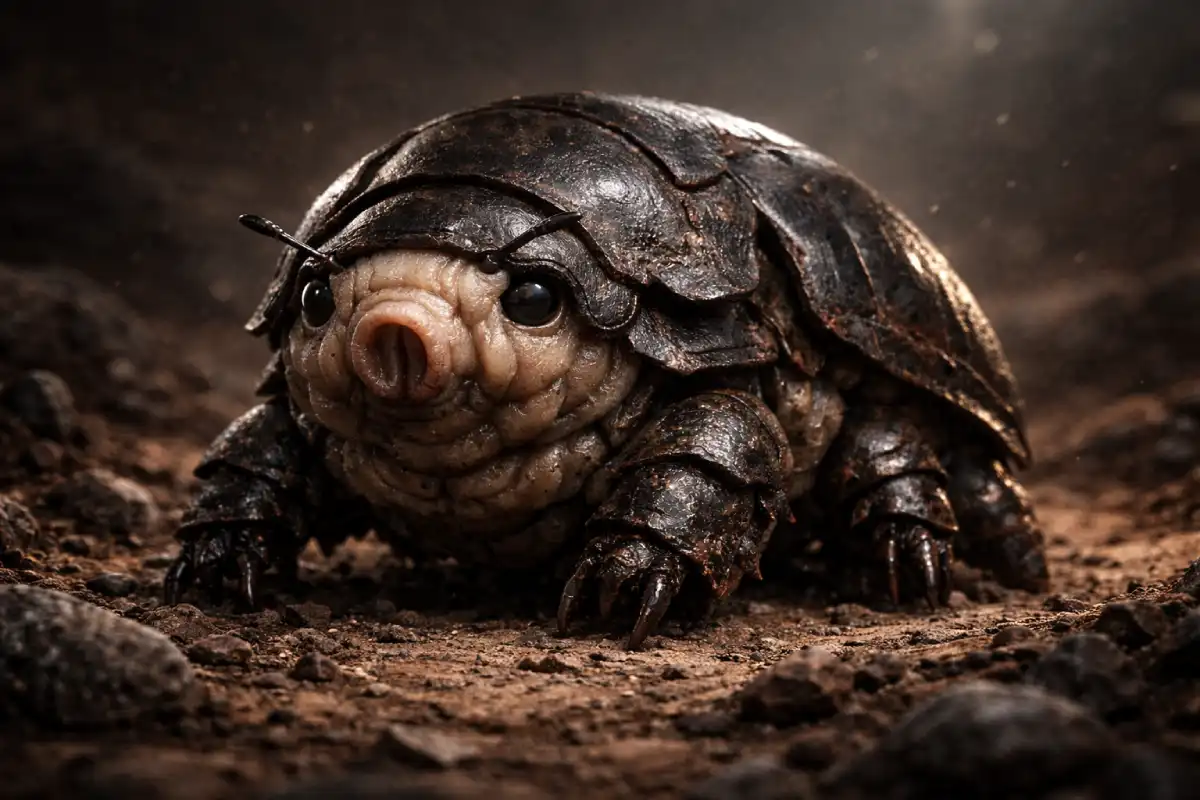
The body would probably be compact and heavily armored, with a rounded shell inspired by the dung beetle. But beneath that tougher outer structure, it might still carry the segmented softness of a tardigrade, creating a strange contrast between hardened protection and flexible biological resilience.
Its legs would likely be short, numerous, and purposeful. Not graceful. Not elegant. Just extremely committed. The kind of legs that suggest this thing has never once considered giving up on anything in its life.
The face would be the real problem.
A tardigrade has that peculiar soft, almost bear-like form when magnified, while a beetle has a far more rigid insect logic to its design. Combine them, and the result might be something slightly bulbous, slightly armored, faintly ancient-looking, with a mouth built for gripping, scraping, and pushing through difficult terrain.
Its eyes, if visible at all, might be tiny and glossy, giving it an expression that feels impossible to read. Not aggressive. Not friendly. Just deeply focused on whatever strange mission occupies its tiny durable mind.
From far away, it might look odd but manageable. Up close, it would probably feel like something from a beautifully designed science-fiction ecosystem.
Its powers would be bizarrely impressive
If this hybrid creature inherited the best qualities from both sides, its ability set would be ridiculous in the most entertaining way.
Extreme survival
This would be its signature gift.
Like a tardigrade, it could potentially endure conditions that wipe out more fragile creatures. Heat that dries everything. Cold that locks movement away. Pressure that crushes the ordinary. Environments so harsh they feel more like endings than habitats.
It would not shrug these off dramatically. It would simply persist in a calm, stubborn way, as if devastation were just weather.
Unreasonable determination
A dung beetle’s personality, if it can be called that, feels defined by commitment. Once it starts a task, it seems fully prepared to continue through resistance, awkward angles, and complete indifference from the rest of the world.
This fused creature would likely inherit that relentless spirit.
If it chose a direction, it would keep moving. If it found material worth collecting, it would keep working. If something blocked its path, it would not panic. It would just become the kind of tiny problem that refuses to go away.
Miniature strength
For its size, it might be absurdly powerful. Not in the exaggerated way of comic-book heroes, but in the very real and slightly disturbing way that insects already are. Tiny creatures can be shockingly strong when compared to their own body mass. Add enhanced structural toughness and persistence, and you get something that seems built to outwork physics rather than impress it.
Disaster endurance
This is where the imagination starts having too much fun.
Most creatures need the world to stay reasonably stable. This one would feel designed for instability. Drought, pressure, contamination, collapse, scarcity, exposure. In a brutal environment, it would not necessarily thrive elegantly, but it might remain functional long after more delicate animals vanished.
It would be less like a survivor in the heroic sense and more like a tiny biological machine that never received the message that the crisis was supposed to stop everything.
Would it be terrifying, useful, or strangely adorable?
The most honest answer is probably all three.
It would be terrifying because anything that can survive too much starts to feel slightly unnatural, even when it is still part of nature. There is something deeply unsettling about a tiny creature that remains calm while conditions around it become disastrous.
It would be useful because dung beetles already contribute to ecological cleanup. A tougher, stranger version of that idea could become an imagined specialist of harsh environments, breaking down material, moving organic matter, and restoring some kind of order after ecological chaos.
And yet, somehow, it might also be weirdly adorable.
Not cute in the usual soft, cuddly way. More in the way that certain strange deep-sea animals or unusual reptiles become lovable precisely because they look so committed to being themselves. A little ugly. A little noble. A little absurd. Entirely unforgettable.
It would probably earn the kind of affection reserved for creatures that seem too stubborn to hate.
Could it survive the end of the world?
This is the question that turns the entire thought experiment from fun to cinematic.
Picture a ruined landscape after heat, drought, ash, cold, collapse, or some chain of disasters that leaves the world silent and brittle. Most life would either flee, fail, or wait for better conditions. But this fused creature might still be there, moving across the broken ground with patient, insect-like certainty.
Not rushing. Not panicking. Just continuing.
Perhaps it finds some remnant of organic material and begins doing what it was built to do: gather, move, shape, preserve, endure. A creature too small to become a monster in the cinematic sense, but perfect as a symbol of something more unsettling — life that simply refuses to stop.
In that sense, it would not just survive the end of the world. It would quietly outlast the drama of it.
That may be the strangest part of all.
It would not look like a conqueror. It would look like a worker. A bizarre tiny laborer crossing the remains of disaster with the calm confidence of something that was always overprepared.
It might become nature’s weird little tank
If humans ever gave it a nickname, it would probably end up with something half affectionate and half alarmed. Something like ash beetle. Dust bear. Ruin roller. Apocalypse bug.
Whatever the name, the identity would stay the same: a tiny armored survivor with far too much endurance and not nearly enough interest in surrender.
That is what makes this imagined fusion so satisfying. It does not feel random. It feels strangely believable at an emotional level, even if biology would strongly object. The tardigrade gives it impossible patience. The dung beetle gives it physical insistence. Together, they create a creature that feels designed for the exact moment everything else becomes uncertain.
Not glamorous. Not majestic. Just unbelievably hard to stop.
Nature is already stranger than science fiction
The best part of this whole thought experiment is that it only works because the original animals are already so extraordinary.
Tardigrades are real. Dung beetles are real. One survives like a biological myth. The other works with a level of commitment that borders on comedy. Put those two facts beside each other, and the line between science and imagination starts feeling unusually thin.
That is what makes nature so endlessly fascinating.
You do not always need aliens, giant monsters, or futuristic laboratories to create something memorable. The raw materials are already here. Tiny animals. Strange instincts. Impossible resilience. Odd beauty. Brutal efficiency.
Sometimes all imagination has to do is look at reality, smile slightly, and ask one reckless question.
What if these two became one?
Final thought
If a tardigrade and a dung beetle ever became one creature, it would probably be small, armored, bizarre, relentless, and almost comically difficult to destroy.
It might terrify some people. It might fascinate others. It might look ridiculous and impressive at the same time. But above all, it would feel like a reminder that the natural world has never lacked imagination.
Even when we invent impossible hybrids for fun, we are often just borrowing from a reality that was already far stranger than it had any obligation to be.
And honestly, that may be why this tiny imagined creature feels so strangely perfect.