
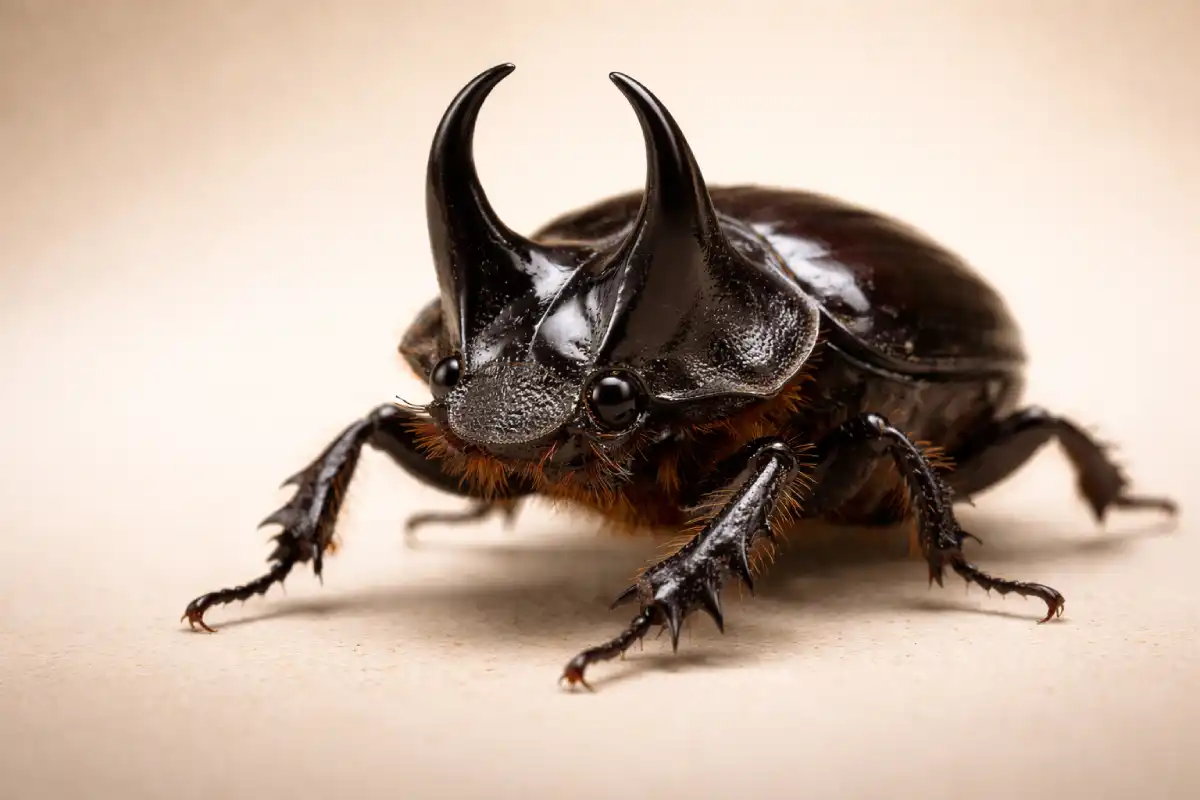
There’s a beetle that can pull a ridiculous amount of weight for its size.
So naturally, the next question is:
What if that beetle was human-sized? Would it pull a truck? Would it become a real-life superhero?
The “strongest insect” (relative to body weight)
The horned dung beetle (Onthophagus taurus) is often reported as one of the strongest insects relative to body weight. In tests, it has been measured pulling up to 1,141× its own body weight. That’s not a typo.
If you want the quick headline version: Science (ScienceShot) covered the 1,141× claim, and ScienceDaily summarized the “world’s strongest insect” story.
Okay… give that power to a human
Let’s do the fun math.
If a 70 kg human had the same relative pulling performance:
70 × 1,141 ≈ 79,870 kg (≈ 80 metric tons)That’s in the range of a loaded truck. Sounds like a superpower.
Now the twist: scaling breaks the superpower
When you scale an animal up, its weight (volume) grows faster than the cross-sectional area of its muscles.
This is the square–cube law:
- Scale length by k
- Muscle cross-section (strength) scales ~ k²
- Mass/weight scales ~ k³
- So relative strength scales ~ 1/k
Meaning: a creature scaled up gets relatively weaker, even if it looks the same.
What happens at “human-sized” beetle scale?
A dung beetle might be around ~10 mm long. A human is roughly ~1.7 m tall.
That’s a scale factor of about:
1.7 m / 0.01 m = 170× biggerIf relative strength drops roughly by 1/170, the “1,141×” headline becomes:
1,141 ÷ 170 ≈ 6.7× body weight (rough estimate)Still strong, but not “drag a truck like nothing.” And this is a generous estimate because real biology adds extra problems.
Why a giant beetle would “fail” in real life
Even if muscles scaled perfectly, a giant insect runs into brutal constraints:
- Exoskeleton stress: the shell would need to be disproportionately thicker to support the extra load.
- Joint forces: tiny joints at small scale become failure points at large scale.
- Breathing: many insects rely on spiracles/tracheae; scaling oxygen delivery becomes difficult.
- Heat: bigger bodies generate more heat and lose it differently.
This is why “giant insects” are so hard to make plausible without changing the design.
The real superpower is engineering, not size
Here’s the fun conclusion:
If you want beetle-level strength at human scale, you don’t copy the shape. You copy the idea:
- Better leverage (mechanics)
- Better materials (structure)
- Better load paths (design)
Nature already solved strength. Physics just forces different solutions at different sizes.
Sources & further reading
- Science (ScienceShot): “World’s strongest insect” (1,141× claim)
- Current Biology (Cell): Dung beetles overview (mentions 1,141×)
- ScienceDaily: “Pulling power points the way to world’s strongest insect”
- J.B.S. Haldane: “On Being the Right Size” (classic scaling essay)
- Square–cube law (overview + references)
Want your website to feel “strong” in 5 seconds?
If you want a quick trust check (no redesign pitch), send your website URL. I’ll reply with a short action list.
← Back to Affiq LogSupport Independent Work
If my work or articles help you, you can support my independent work here.
Support