
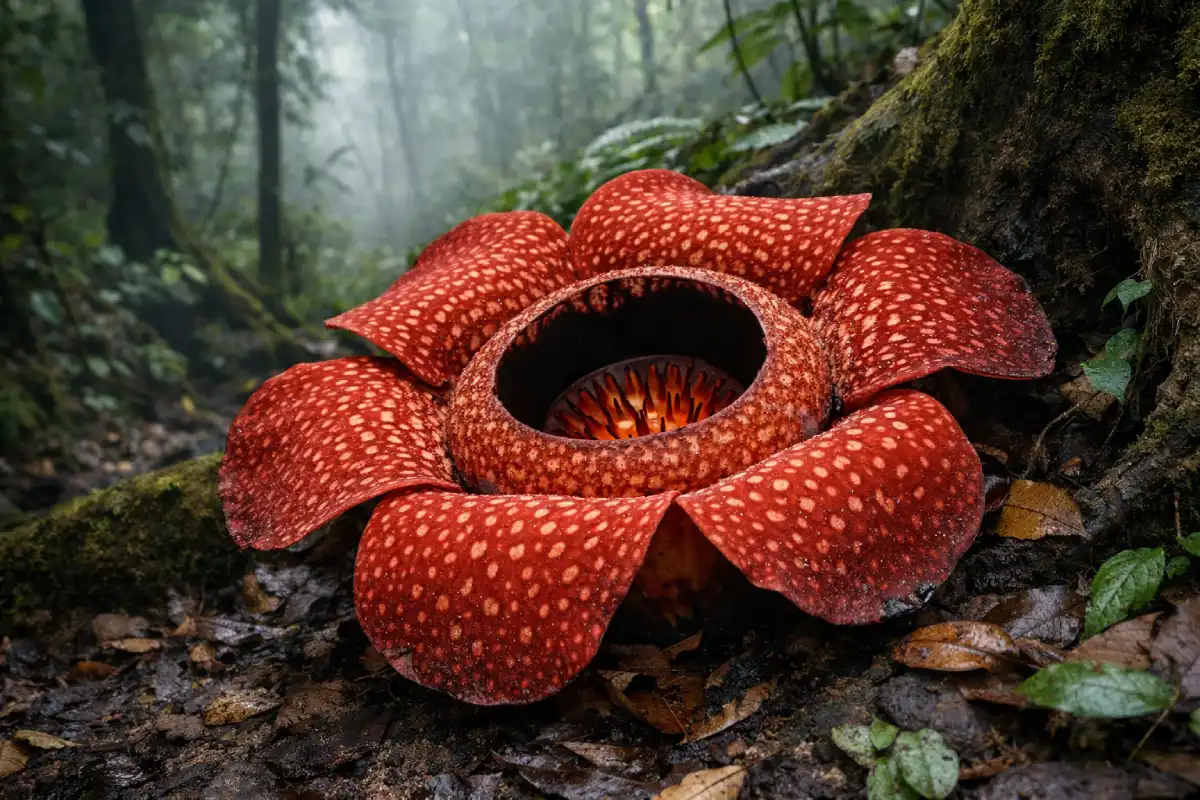
I didn’t plan to write about a flower today.
I planned to write about nothing. A clean day. No tabs. No “I should.” Just air, trees, and whatever the forest decides to show you.
But then someone said a sentence that doesn’t sound real:
“It’s a flower… But it doesn’t have leaves.”
That’s the moment you stop walking normally and start walking like you’re hunting a myth.
The flower that refuses to be a plant
Rafflesia is one of the strangest things you can call a “plant.” Because it basically skips the parts we usually associate with plants.
No leaves. No stems. No roots. No “look at me, I’m photosynthesizing” energy.
Most of its life is hidden. It lives inside a host vine, quietly taking what it needs. Then, when the timing is right, it appears above ground as one massive bloom, like the forest spawned a boss level.
It’s not “pretty” in the normal flower way.
It’s cinematic.
First sight: it doesn’t feel like a flower
The first time you see one (even in photos), your brain tries to label it fast:
- “Mushroom?”
- “Sea creature?”
- “Alien pancake?”
Then you notice the texture, thick, fleshy, almost unreal. The petals look like they belong to something that crawls, not something that grows.
And the size doesn’t help. Some species are famous for being among the largest single flowers on Earth. It’s not a “bouquet” flower. It’s a “stand back a bit” flower.
The smell (yes, people weren’t exaggerating)
Okay. The smell.
Rafflesia is often described as smelling like rotting flesh. That sounds like a dramatic internet line, until you’re near it.
It’s not “bad perfume.” It’s not “old socks.”
It’s more like: nature doing a very specific trick on your senses.
And here’s the weird part: it’s not trying to offend you. It’s trying to attract its pollinators. Flies and other carrion-loving insects don’t want sweet floral scents. They want the opposite. This bloom is basically a biological billboard that says:
“Something is decomposing here. Come check.”
The blink-and-miss-it window
The cruel joke is how short-lived the moment is.
A Rafflesia bud can take months to develop. Then the flower opens… and you get a few days. Roughly a week in many cases. After that, it collapses back into the forest like it was never there.
Which is why people keep saying the same thing about seeing one:
“You’re lucky.”
Not because it’s hidden behind a paywall. Not because it’s a secret club.
Because the timing has to align: the right place, the right trail, the right week, the right bloom.
Why it’s so hard to “plan” a Rafflesia encounter
Rafflesia is picky. And the ecosystem around it is picky too.
- It depends on a specific host vine (often a Tetrastigma vine).
- It spends most of its life embedded in that host.
- Male and female flowers exist separately, and successful pollination needs good timing.
- The blooming period is short, so the window for success is tiny.
So when you hear “it’s blooming,” what that really means is: a rare chain of conditions is currently holding. And it won’t hold for long.
If you ever go looking for one
This is the part where I get serious for a second.
Rafflesia isn’t a “pose for Instagram” object. It’s fragile, rare, and tied to a specific habitat. If you ever visit a park or trail where it blooms, the best move is the simplest:
- Stay on the trail. Don’t trample the surrounding area to get a closer angle.
- Don’t touch. “Just a little tap” is still stress.
- Follow the park’s guidance. If they say don’t approach, don’t negotiate.
- Take the photo, leave the place intact.
The flex isn’t “I got closer.” The flex is: it still blooms there next year.
What I like about it (beyond the weirdness)
Rafflesia feels like a reminder that nature is not always elegant.
Sometimes it’s efficient. Sometimes it’s brutal. Sometimes it’s a plant that decided:
“I’m not going to build leaves. I’m going to build one impossible flower… and vanish.”
It’s not here to be pretty. It’s here to survive.
And for a few days, it wins.
Sources (for the curious)
- Royal Botanic Gardens, Kew — Rafflesia arnoldi
- Encyclopaedia Britannica — Rafflesia
- Encyclopaedia Britannica — Rafflesiaceae (5–7 day bloom note)
- American Journal of Botany (1988) — Pollination of Rafflesia
Small note
If you’re ever trying to see Rafflesia in real life, check with the park office first. Blooming is a timing game.
If you want me to check your website
I write random things sometimes, but I still build clean, fast, trust-first sites. If your site feels “off” and you can’t explain why, send your URL. I’ll reply within 1 business days with a short fix plan.
← Back to Affiq LogSupport Independent Work
If my work or articles help you, you can support my independent work here.
Support