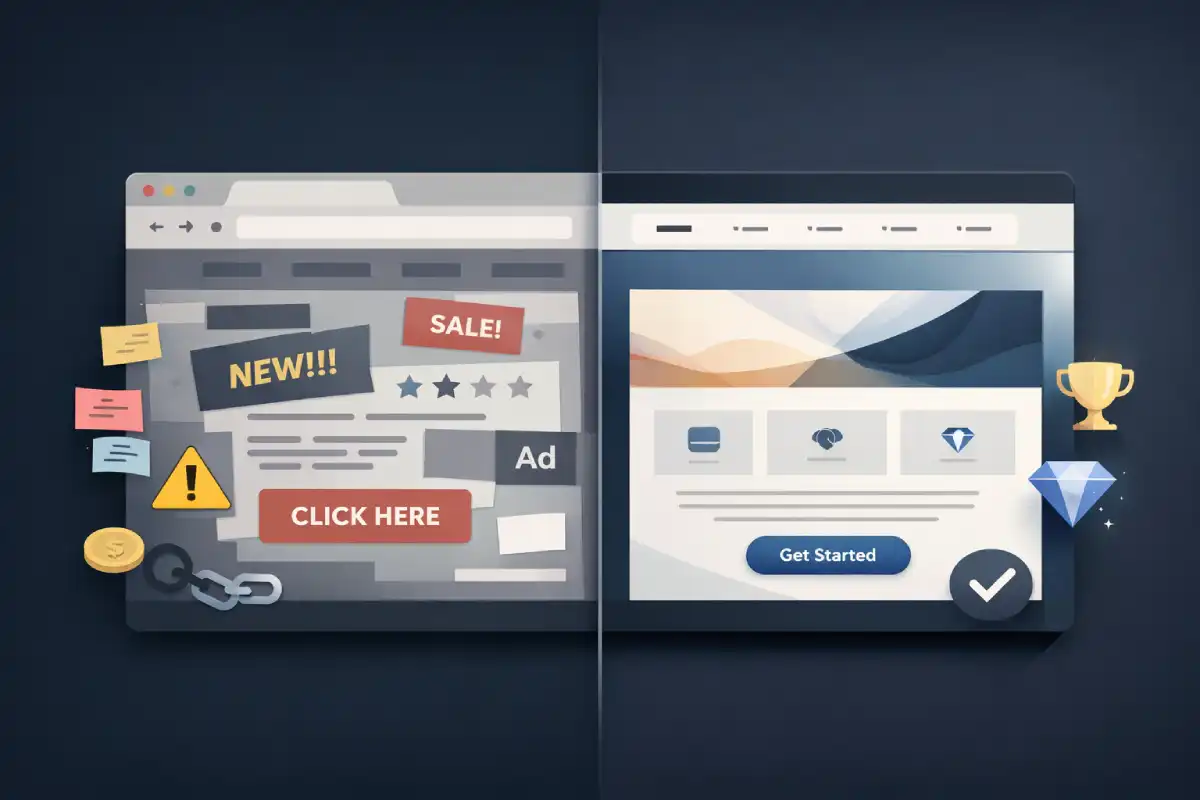
A cheap-looking website is not just a visual problem.
It is a business problem.
Many people assume that if a website works, loads reasonably well, and shows the basic information, that should be enough. But in reality, the way a website feels can shape how people judge the business behind it long before they read the details.
That is where the real cost begins.
A cheap-looking website does not always fail in obvious ways. Sometimes it still gets traffic. Sometimes people still click around. Sometimes it still technically does its job. But underneath that, something more subtle happens: trust weakens, perceived value drops, hesitation grows, and the business ends up paying for it in ways that are easy to miss.
The problem is not just how it looks
When people say a website looks cheap, they are usually not talking about one single thing.
They are responding to a combination of signals.
It could be weak spacing, inconsistent typography, poor image choices, cluttered sections, unclear hierarchy, awkward mobile layout, or copy that feels unsure of itself. Even when none of those issues seem dramatic on their own, together they create a feeling.
And that feeling becomes a judgment.
Visitors do not experience a website as a checklist. They experience it as an impression. In a matter of seconds, they start forming opinions about whether the business feels credible, capable, professional, modern, and worth trusting.
That is why a cheap-looking website can quietly damage a good business.
What “cheap-looking” actually signals to visitors
Most business owners do not intentionally make their websites feel cheap. In fact, many of them have good services, real experience, and honest intentions.
But websites communicate more than information. They communicate standards.
A cheap-looking website can signal things like:
- this business may not be established
- this service may not be worth premium pricing
- the details may not be handled carefully
- the brand may not be fully serious
- there may be less professionalism behind the scenes
Even when none of those things are true, the presentation can still create that impression.
And once that impression forms, the visitor starts reading everything through that lens.
A weak visual presentation can make strong copy feel less convincing. A good offer can feel ordinary. A trustworthy business can start to feel like a risk.
The hidden costs of a cheap-looking website
The most expensive part of a weak website is usually not the design itself.
It is the cost that appears after people land on it.
1) It lowers trust before trust has a chance to form
Trust is fragile online.
People do not arrive at a website ready to believe everything they see. They arrive with uncertainty. The website’s job is to reduce that uncertainty as quickly as possible.
When the site feels cheap, that process becomes harder.
Instead of feeling reassured, the visitor becomes more cautious. Instead of moving closer to action, they stay guarded. Instead of thinking, “This looks solid,” they start thinking, “I’m not sure about this.”
That hesitation is costly, even when it never shows up directly in analytics.
2) It makes good businesses look ordinary
A business can be genuinely excellent and still look average online.
That is one of the biggest hidden losses.
If the website fails to reflect the quality of the service, the visitor has no clear reason to place that business above the many others competing for attention. Expertise becomes less visible. Care becomes less visible. Positioning becomes weaker.
In other words, the business may be better than its competitors, but the website does not help prove it.
And when quality is not clearly felt, visitors often fall back on the easiest comparison available: price.
3) It reduces pricing power
This is where the damage becomes more serious.
A cheap-looking website often makes premium pricing feel harder to justify.
That does not mean people consciously think, “This website looks cheap, so the service should be cheaper.” Often the process is subtler than that. They simply do not feel enough confidence, authority, or polish to comfortably accept a higher price.
Perceived value plays a major role in pricing.
If the presentation feels weak, the service behind it often feels less valuable, even when the actual work is strong. And once that happens, pricing conversations become more difficult. More friction appears. More doubt appears. More leads become price-sensitive.
4) It attracts the wrong kind of leads
Websites do not just influence conversion rates. They also influence lead quality.
A polished, trustworthy site tends to attract people who are comfortable with quality and more ready to take the business seriously. A cheap-looking site often does the opposite.
It can attract people who are browsing casually, comparing only on price, or looking for the cheapest possible option. At the same time, it may quietly repel the kinds of clients the business actually wants: people who value professionalism, clarity, and confidence.
That means the website is not just underperforming. It may be filtering in the wrong direction.
5) It creates more manual work for the business owner
When a website fails to carry trust properly, the owner has to make up for it elsewhere.
That usually shows up in conversations.
More explaining. More reassuring. More answering basic questions. More effort to prove legitimacy. More time spent trying to create confidence that should have already started on the website itself.
A strong website reduces friction.
A weak one shifts that burden onto email, WhatsApp, calls, and manual follow-up. That may not look like a design cost at first, but it becomes an operational cost over time.
6) It makes hesitation feel reasonable
One of the most dangerous effects of a cheap-looking website is that it makes delay feel justified.
Visitors may not always know exactly what feels off. They may not be able to explain it clearly. But they feel enough uncertainty to pause.
They think:
Maybe later.
Maybe I should compare more options.
Maybe I need to think about it first.
Maybe this is not the right fit.
That hesitation often has less to do with the offer itself and more to do with how safe, clear, and credible the business feels in that moment.
And if the site does not create that feeling, even a good opportunity can quietly fade away.
What makes a website feel more premium and trustworthy
A premium-feeling website is not necessarily flashy.
It does not need dramatic animations, luxury aesthetics, or expensive-looking effects. In many cases, those things can even make the site feel less trustworthy if used badly.
What matters more is clarity, restraint, and confidence.
A website tends to feel more premium when it has:
- strong spacing and breathing room
- clear visual hierarchy
- consistent typography
- fewer but better design elements
- confident, direct copy
- clean mobile presentation
- thoughtful calls to action
- relevant trust signals
- strong alignment between branding and offer
- a sense that the details were handled deliberately
In other words, a premium feel comes from control.
It feels intentional. It feels calm. It feels capable.
And that feeling shapes how people interpret the business.
A better website does more than look good
A good website is not just there to appear modern.
It is there to help the business communicate value faster, reduce hesitation earlier, and create trust more efficiently.
That is why the best websites do more than display information. They support positioning. They improve first impressions. They strengthen pricing power. They attract better-fit leads. They reduce the need for over-explaining.
They make the business feel more established before the conversation even begins.
That is real business value.
Final thought
A cheap-looking website rarely announces its cost out loud.
The loss usually happens quietly.
It appears in leads that never inquire, visitors who hesitate, pricing conversations that feel harder than they should, and opportunities that drift away without a clear reason.
That is why this is not just a design issue.
It is a trust issue. A positioning issue. A perceived value issue.
And in many cases, the business ends up paying far more for that weak impression than it ever expected.